What is Love?
I've got love on my mind! Love is maybe the most complicated and beautiful concept humanity has tussled with for generations.
Often, we find love in relationship with other people, although we can find love in nature and in more abstract ways. It can be so confusing to figure out if what we are experiencing with someone is indeed love, as a counsellor, I have heard many stories where love felt altogether wonderful and frustrating.
What I call the “love triangle” is Sternberg’s theory of love. this tool is a way I like to zoom out of relationships and see what components make up what Sternberg calls “love profiles”. continue reading for Sternberg’s 8 love profiles. what kind of love have you experienced?
If you have ever been curious about the many complicated and different types of love we experience in life, this is a great theory to explore! I have outlined Sternberg's popular theory of love and the 8 profiles love can create through the 3 main components of intimacy, passion, and commitment! In this theory, Sternberg describes these 3 components as,
“Intimacy: the closeness each partner feels to the other and the strength of the bond that binds them together. Partners high in intimacy like value and understand their partners.
Passion: based on romantic feelings, physical attraction, and sexual intimacy with the partner.
Commitment: represents cognitive factors such as acknowledging that one is in love and committed to maintaining the relationship.” (Myers, 2023)
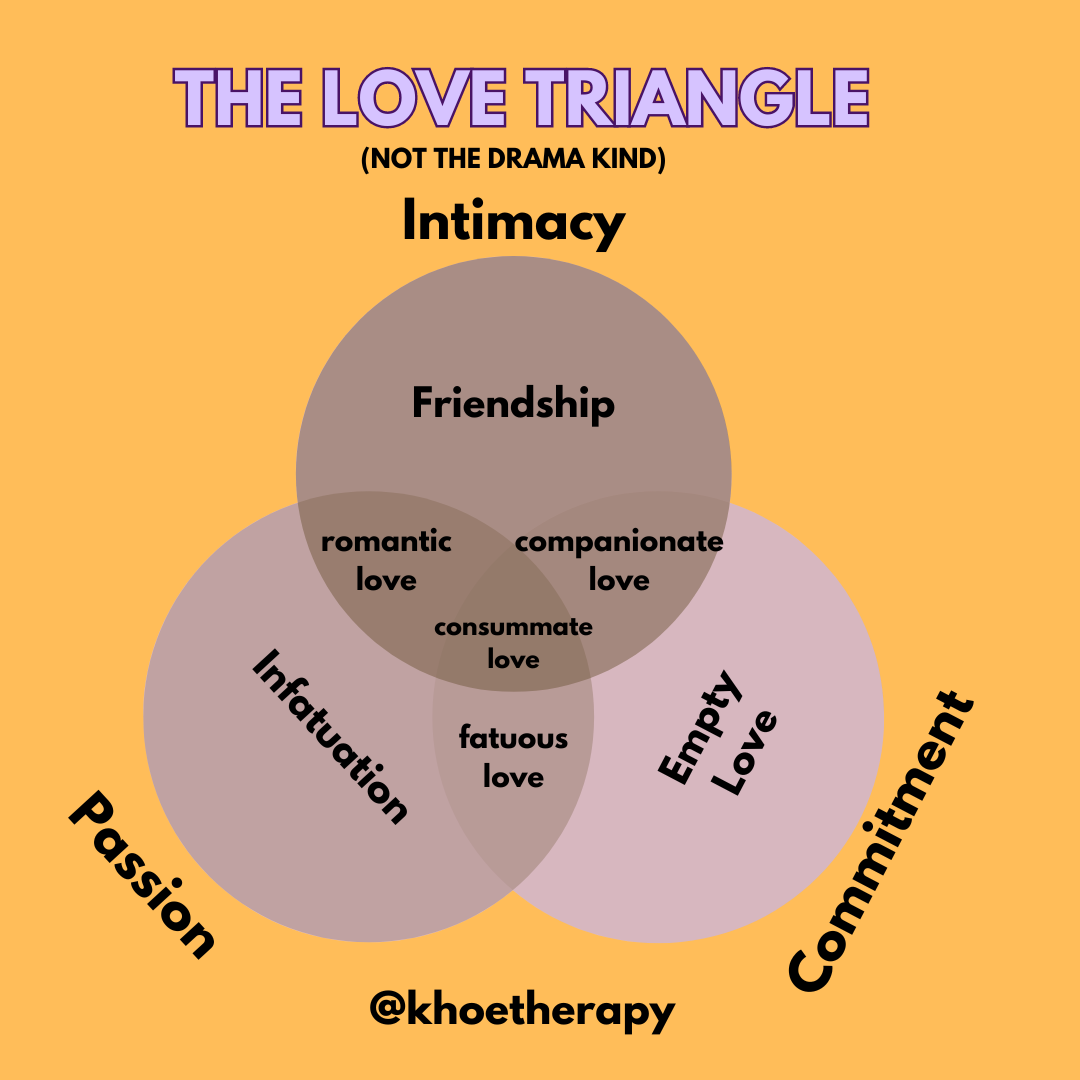
I will list the 8 profiles of love and the components they encompass, as you read through, think of some relationships that have 1 or more components and where the relationship may fall in this theory:
Non love - none of the components present, often characterized as “everyday relationships” (Sternberg, 1986, p. 123).
Friendship (liking) - intimacy is present, described as being bonded and warm in feeling (Sternberg, 1986).
Infatuation - passion is present, associated with “love at first sight" (Sternberg, 1986, p. 124) or attraction.
Empty love - commitment is present, sometimes called a roommate type of relationship where practical living is the main hold over the relationship.
Romantic love - intimacy and passion meet in this type of love, Sternberg calls this the “Romeo and Juliet” (1986) of the love types. Although there is plenty of desire and closeness, there is no commitment.
Companionate love - intimacy and commitment intertwine in this love type, creating a close and reliable relationship although there is either a lack of or absence of “spark” (Sternberg, 1986).
Fatuous love - passion and commitment forge this love type, one that Sternberg describes as, “whirlwind courtships” (1986, p. 124) where friendship has not deepened.
Consummate love - Lastly, the combination of intimacy, passion and commitment form what Sternberg calls consummate love. This love type is often idealized as “unconditional love” (Sternberg, 1986), and as one can imagine, takes the patience of time to develop intimacy, the uncontrollable nature of passion to be maintained and the strength of commitment to be reestablished time and time again.
This theory has helped me and many clients sort out the particular components in their relationships and find words that describe the kind of love they are experiencing. By defining the kind of love we experience, it can help us to appreciate what we receive in said relationship and what we are still seeking.
So, what do these categories mean for you? Notice any relationships pop up in your head as you read some of these?
Read my 2 other blog posts on love and the 5 senses and love through language!
Love, what a wonderous thing.
With love and solidarity,
Chantel